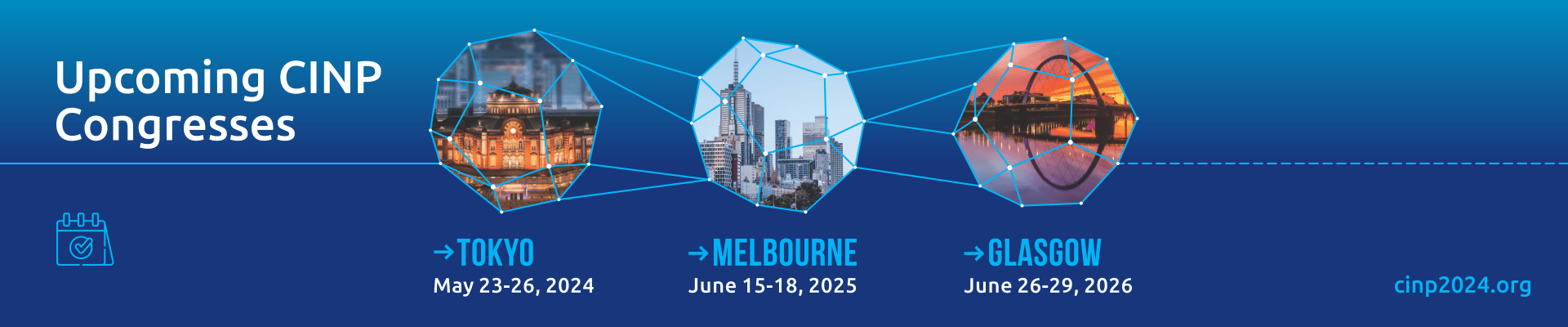
CINP organises a variety of different meetings in line with its key objectives of furthering research, education and improving clinical care.
Think Tank 2012 and looking forward to 2013

Last September Oktoberfest was not the only event to occur in Munich!
A dedicated group ignored the siren call of dirndl and lederhosen (at least during the daytime), descending on Munich to attend the inaugural CINP “ThinkTank”. The brain child of Brian Dean, this small assembly focussed on “Fill the Emptying Drug Pipeline: Strategies for Basic Researchers”.
Thanks to the efforts of Hans-Jürgen Möller, the generosity of Peter Falkai and the organisational skills of CINP head office, the meeting took place in Alzheimer's Saal, in the Psychiatric Department at Ludwig-Maximilians University. Although the room is now set up for meetings, echoes of its history as Alzheimers’ anatomical laboratory are to be found in the display cases that ring the perimeter containing mementos of the days when Kraepelin, Alzheimer and Nissl worked there.
The meeting started with Hans-Jürgen Möller reviewing the impact neuropsychopharmacology has had on the lives of people with psychiatric disorders. Hans-Jürgen provided a timely reminder that less than 80 years ago the forefront of treatment for psychiatric disorders were baths and insulin. Things changed dramatically in the period between 1952 and the mid 1970s with an explosion of new drugs relegating the old asylums to history. This smorgasbord of medications was not restricted to psychiatry; as Torgny Svensson pointed out the same profusion was seen in all medical disciplines. A far cry from the current state of affairs where there are few drugs for psychiatry on the horizon – the question posed to the attendees was “what has changed and what can we do to reverse the effect?” resulting in very lively debate which proved to be the hallmark of the meeting.
Brian Dean did nothing to quell discussion with his presentation, which explored the concept that understanding the causes of psychiatric disorders will influence drug design. From the fact that we don’t fully understand the biology of many of the behaviours that are affected by the disorders to the role that serendipity played in the development of many of the early drugs such as iproniazid, Brian covered a lot of ground and whilst doing so provided a great deal of food for thought and discussion. The depth of knowledge within the group was encyclopaedic, resulting in formidable arguments and counter-arguments.
Mark Millan then discussed some of the issues surrounding drug development – providing excellent insights into this process. One of the biggest changes has been the focus on high throughput screening against rational drug targets, drawing resources away from classic pharmacology. Another is that the slightest indication of safety concerns results in the drug being dropped – irrespective of how efficacious it might be. A major bugbear is the vexatious issue of the “placebo response”; for example 60% of potential antidepressant drugs fail placebo controlled trials, as do some of the comparison antidepressants despite being approved by regulatory authorities! Does this mean that the drugs are not effective? The answer was an empathic “No” leading to lively discussion about the possible causes of the placebo response and how it might be circumvented.
We next turned the spotlight onto the role of animal models, with Mark Geyer pointing out that until we understand the aetiologies of psychiatric disorders we won’t have true models. However, until then it is possible to use animal models as long as we do so in full appreciation of the model, what is being assessed and what that measure actually means. Mark reviewed some of the “hits” (reversal of apomorphine –induced disruption of pre pulse inhibition as a screen for antipsychotic activity) and “misses” (a number of pro-cognitive models), before discussing the latest approach of identifying parallel paradigms between laboratory animals and humans. For example; startle tests can be used across species, some neuropsychological tests (specifically CANTAB) have been adapted to touchscreens which mice can use and applying locomotor tracking to map exploratory behaviour in humans is as successful as in laboratory animals.
Some of the attendees took the opportunity to present their research and potential applications to the “Thinkers”. Immune related genes were an avenue of research, with Andrea Schmitt discussing changes in gene expression in schizophrenia and Angelos Halaris discussing the relationship between inflammatory pathways and the nicotinic receptor signalling in major depressive disorders. Andrew Gibbons expanded the discussion of the cholinergic system in mood disorders to include his data on muscarinic M2 receptors in major depressive disorder and bipolar disorder. Amir Kalali from Quintiles presented his thoughts on how the current model used for drug trials and the monitoring of compliance could be improved. Christian Schütz explored the potential of commonalities between substances that are abused and psychiatric disorders for generating a better understanding of the pathophysiology of disorders. Elizabeth Scarr discussed the problems of regarding what she believes to be the syndromes that constitute psychiatric disorders as a single entity both for understanding the pathophysiology and the development of therapies. This session was highly interactive, with the discussions ranging from minutiae to big picture scenarios – stimulating enough to work up the serious appetites needed for the evening spent sampling traditional Bavarian fare. The evening requires a big “Thank You” to the Munich residents past and present who took the time to educate the non-residents as to what it was they were actually ordering!
The second day of the “ThinkTank” started with what should have been the final presentation of the previous day; Chris Turk discussed his work on using animal behaviours to identify potential biomarkers for psychiatric disorders employing network and pathway analyses. This presentation flowed nicely into the final topic of discussion lead by Dan Rujescu – personalised medicine and the role played by genetic studies, what has been achieved and what needs to be done.
Finally, Torgny Svensson concluded the meeting by summarising the meeting. Torgny started by succinctly addressing the raison d’ être for this particular ThinkTank - the bleak landscape of drug development for psychiatric disorders before summarising two days of talk in 6 bullet points:
- We need to increase collaboration between basic researchers, clinical researchers and Industry.
- We should not lose sight of our goal; to improve the mental health of patients.
- Allosteric modulation has potential as a therapeutic approach.
- The “placebo response” needs to be mitigated.
- Animal models should be used within defined parameters
- The area of “immune” proteins holds distinct promise for the development of new therapies – or the redeployment of old ones.
29th World Congress: 22-26 June 2014 - Vancouver, Canada

The CINP 29th World Congress takes place in 2014 from 22-26 June in Vancouver, Canada.
The deadline for submission of Symposia papers is extended to:
**1st March 2013**
The CINP International Scientific Programme Committee welcomes proposals that link the latest preclinical developments with clinical research on a given topic. CINP supports a strong focus on new approaches to the development and assessment of CNS pharmaceuticals by researchers working in both academia and industry through the free and open exchange of ideas.
The programme topics are:
A) Diseases of the Nervous System. Current preclinical and clinical perspectives
C) Innovation in Therapeutic Development and Assessment of Drugs and Stimulation devices
D) Developmental Perspectives on Neuropsychopharmacology
E) Integrative Approaches to Neuropsychopharmacology
We look forward to receiving your symposium submission for consideration. To submit please click here and follow the guidelines.
Other deadlines to note are:
- June 2013 - Poster Abstract Submission OPENS
- 5th Feb 2014 - Early Bird Registration - 1st Deadline
- 5th Feb 2014 - Poster Abstract Submission - Deadline
In the coming months we will also announce our Plenary speakers and details of our awards programe so please keep checking www.cinp.org for updates and the Congress website, accessed by clicking here.
B) Diseases of the Nervous System (Techniques). Current preclinical and clinical perspectives
Congress
Biennial International Congresses
Leading edge meetings of major impact. These are large international meetings held in major cities around the world. They provide a forum for the presentation of the latest findings in neuropsychopharmacology and allow the world’s leading scientists and clinicians to exchange ideas and information. They include plenary lectures, cutting edge scientific symposia, poster sessions and educational and scientific workshops. These are acknowledged to be among the very highest quality scientific programmes in this field. They have delegates from all around the world and an excellent mixture of clinicians and basic scientists from all backgrounds.
Vancouver 2014 - Following the success of the 28th Congress in Stockholm in June of this year we now look forward to our 29th Congress. The 29th Congress will take place in Vancouver from 22-26 June 2014. For further information on the Congress just past in Stockholm and to receive any news regarding the forthcoming Congress in 2014 please visit www.cinp2012.com.
International Thematic Meetings
These are an innovative and exciting new format of CINP meeting which began in 2009. They are international in scope with a mixture of scientific symposia and a significant number of education sessions. They are focused on a single theme and concentrate on specific topics while also incorporating educational and professional development in addition to research sessions. They are expected to be considerably more intimate than the major biennial international congress and provide an optimal environment for the sharing and exchange of knowledge and ideas.
Jerusalem 2013 - Follwing from the success of our last thematic meeting, which took place in Salzburg, Austria on 1 - 3 April 2011, we now look toward our next meeting. The next meeting takes place in Jerusalem from 21-23 April and will centre on Pharmacogenomics and Personalised Medicine in Psychiatry. For more information on the meeting and to participate please click here to go to the website.
Regional Meetings
The CINP regions organise their own regional meetings, in order to facilitate and stimulate the regional research environment. The next regional meeting will take place in Kuala Lumpur from 1-4 October 2013. Please click here to visit the meeting website.
Annual Meetings
The first CINP annual meeting happened in Munich from 13-15 Sept 2012. This meeting took a more informal approach to the meeting formula as indicated by its title Think Tank. There were 7 main discussants whose aim was to advance current thinking on significant problems faced within the field of basic neuropsychopharmacology. The 2nd Think Tank will take place in the latter half of 2013, please keep checking our website for forthcoming details on this meeting.